Wednesday, June 26, 2019

Elements and their Correspondence


The traditional western elemental correspondences are as such;

Earth: Relates to the North, the new moon, winter, the color green, life cycles, and midnight. It has power in grounding and that translates into the realms of protection, money, hearth, home, etc. In Tarot and various Pagan paths the element is represented by Pentacles. 

Air: Relates to the East, the waning moon, spring, the color yellow, and sunrise. It has power in communication, moving through unseen realms of thought, wisdom, intellect, etc. In Tarot and various Pagan paths the element is represented by Swords while others Wands.

Fire: Relates to the South, the full moon, summer, the color red, and noon. It has power in heat, purification, destruction, passion, creativity, etc. In the Tarot and various Pagan paths the element is represented by Wands while others Swords.

Water: Relates to the West, the waxing moon, autumn, the color blue, and sunset. It has power in emotion, intuition, change, adapting, blessings, overcoming obstacles, etc. In the Tarot and various Pagan paths the element is represented by cups. 

The Fifth Element: There are some more modern Pagan traditions that use and recognize a 5th element, the element of Spirit. This is also known as akasha or aether and is the bridge between the spiritual and the physical - part of the universal energy.


All of the information regarding the elements, their  Correspondences, and their uses in Alchemy makes sense to me and working with them has never been a problem. So, I have never really felt like I needed to explore the subject at different angles, look through the information with different lenses, or meditate deeply on the elements and their connections. 

It was not until coming across the Blacktree tradition that made me sit back and do a double take regarding the elements and their Correspondences. The Blacktree's interpretation (which was originally put forth by Robert Cochrane and is called The Northern Quarter System which is based out of the four winds of Celtic Tradition) is thus:


Earth: This is placed in the South becuase the Earth dwells beneath our feet. 

Air: This is placed in the North becuase air is above us.

Fire: This is placed in the East becuase the sun rises there.

Water: This is placed in the west because water can always be found in the west. In addition, it is where the sun sets and is the home of the West Gate, where the dead are said to enter the underworld (Hel). 

The elements, their powers, and other associations do not change or differ much other ways.

These correspondences also align with the four qualities given to them by the philosopher Aristotle - hot, cold, dry, and wet.

The Northern Quarter System is a more land based way of looking/interacting with the worlds and how the spiritual interacts with the physical and vice versa.
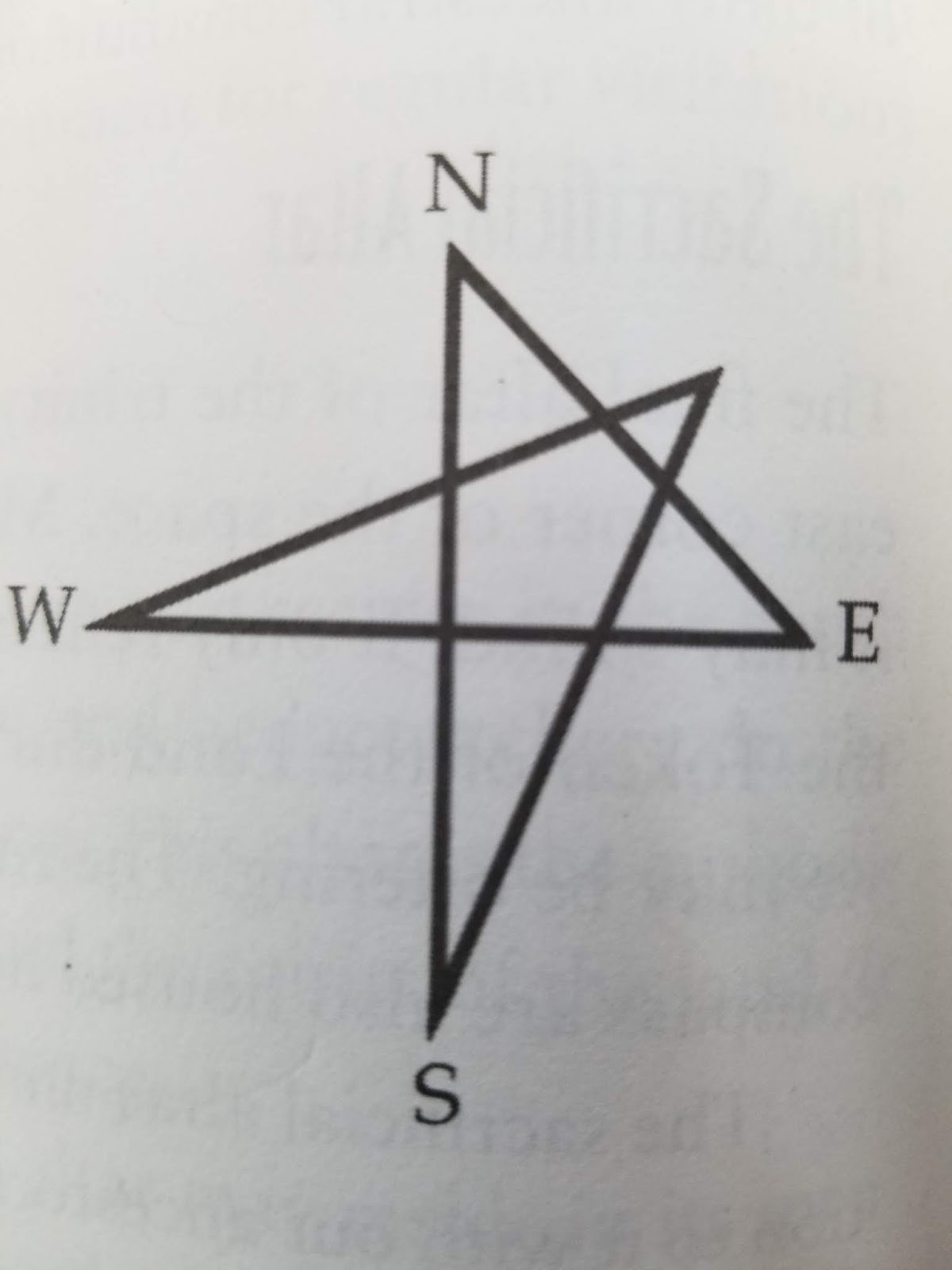

This system also gives us a variation on the traditional pentagram. It stays compass like and there is no discernible way to say there is a right side up or what have you. It also creates a need for different technique when using it to invoke or banish per the techniques put forth by The Golden Dawn in their Lesser Banishing Ritual and others. When invoking the person starts at the point of the element that is being used and traces clockwise and for banishing trace counter clockwise.  

Sunday, June 9, 2019

Gods of the Norse


If one studies the lore and the history of the Norse it quickly becomes clear that their Gods are different then other Gods and Goddesses. These differences have been deduced by the lore, the Norse and their ancestors personally experiences, and all of the modern day personally experiences followers of the path have. The main reasons why the Norse Gods are different are thus:

1. They are not omnipotent 
There are multiple instances and examples in the lore where various Gods go searching for knowledge and wisdom. One such example is Odin plucking out his own eye to gain wisdom from the Well of Mimir.


2. They are not immortal
The Gods rely on the Golden Apples that are kept by the Goddess Idun to stay ageless. They can also be killed. Such examples are in the death of Baldr and Kvisar (in addition to all of the deaths and chaos in Ragnrok). 


3. They are fallible
There are numerous instances where they act out of emotion (Freyr giving up his powerful sword in his quest for love), are morally flexible (The gods made an oath if payment with a person to build a wall around Asgard but found a way to get out of holding up their end of the oath), and go to various lengths to get that they want (Freya slept with multiple dwarves to get the Necklace of the Brisings).


4. They don't necessarily have purviews 
In the lore and history it is rarely stated that the Gods control certain aspects of the realms or are in charge of various elements. The Gods depicted in the primary source materials are larger then life personalities. The Norse, their ancestors, and modern day interpretations/followers of the path have attached various purviews to the Gods based on their personality traits and the types of myths, situations in those myths that they are involved in, the emotions involved in those myths, and personal experiences of the spiritual. These associations have also been popularized by the media, Marvel, and Hollywood.


All of these aspects with the combined knowledge and belief of how the Gods expect their patrons and kin to have a plan B (this promotes self sufficiency and preperation) in life and dealings (they do not pick us up and carry us in the sand) with them makes the Gods very humanistic. This humanistic aspect makes the Gods extremely relatable which helps those on the path.

This is how I talk about the Gods/the divine and relate to the Gods personality. Though, I have been part witness to and part of multiple conversations where one side is describing them like I have and the other side says yes but that is only how they are perceived and experienced with our limited resources (this is meant to represent our five senses, the limitations of our perception by our brain, and other spiritual limitations our physical bodies) - this connects with the fact the existence, time, matter, energy, and space are completely different for the divine and other spiritual beings. This ongoing debate (for lack of a better term) has inspired me to do some research regarding the divine and have gone back to the Vedics. 

This has led to the conclusion that each God simultaneously exists in three different forms. The first form being the anthropomorphic one that the Norse, their ancestors, and the follows of the path experience and relate to. The second form being an celestial existence and this his how they interact on that level, and third being a cosmic intelligence. Cosmic Intelligence is the idea that the deities exist as a force the permeates and is a part of everything (including every person - the divine spark if you will) in the galaxy. It is described in the Srimad Bhagavatam 2.1.32-33:
“Oh King, the rivers are the veins of the Cosmic Person and the trees are the hairs of his body. The air is his breath, the ocean is his waist, the hills and mountains are the stacks of his bones and the passing ages are his movements"

=======

Monday, June 3, 2019

Dime Store Magick


In light of the Altars Four post I have decided now would be a good time to talk about something that I think is very important and more often then not misunderstood.

Modern society has commercialized Paganism. By this I mean that there is a general attitude that makes people feel like they need to have X, Y, Z to be considered faithful or a true walker of the path. This mentality directly feeds into the belief that for ritual work of any kind to be effective and to have an altar that won't be offensive to the spirits/Gods you need the X,Y,Z items and have to say things and move in an exact way. 

This mentality is mainly perpetuated by the literature and the general attitude of people already involved which creates a self sustaining cycle. This happens because the litature itself and the tone (of how it has to be done) of it describes what needs to be on an altar/how to set it up, what items/ingredients are needed for various workings, how you should commune with the spirits, etc. This said litature rarely explains that you can or should improvise, make your own ritual tools, use your own wording, and write your own rituals/spells. Then people armed with these references (or just how they were taught) preach these "necessities" and thus, the cycle continues to perpetuate. 

Do not get me wrong, I think it is great that we easily have access to Pagan litature and supplies. It is the "you need this" or "most do it this way" attitude that is intimidating and creates self doubt in the individual practitioner regarding their faith. I was a victim of this intimidation and self doubt for a very long time - this was what held me back from practicing for a very, very long time. It was not until a conversation with a High Priestess that cleared my beliefs of this need and made me realize that intent, faith, and effort are 90% of it. My first altar (I used it for years) was four different stones that represented the four elements in a little box and a tea candle. 


People need to remember/realize/be taught that ritual tools are metaphorical and help one focus the energy and their mind. In addition, altar items are considered the same as above. Even the Buddha said many time, "My teaching is like a finger pointing at the moon. Do not mistake the finger for the moon." This is something important and powerful to remember when studying Paganism/Spirituality in any shape or form and Manly P. Hall goes on to elaborate that;

...wisdom drapes her truth with symbolism, and covers her insight with allegory. Creeds, rituals, poems are parables and symbols. The ignorant take them literally and build for themselves prison houses of words and with bitter speech and bitterer taunt denounce those who will not join them in the dungeon. Before the rapt vision of the seer, dogma and ceremony, legend and trope dissolve and fade, and he sees behind the fact that truth, behind the symbol the Reality. Through the shadow shines ever the Perfect Light.

These items/tools do not need to be exact or bought and can be improvised. The people's Gods and the spirits will not be offended if you do not have that $300.00 dollar statue of them in the window or some fancy hand carved hammer. A hand crafted token of representation and/or a trip to a thrift/craft/hardware store or the woods (be respectful and thankful) will work just as well if not better becuase the person put in time and creative energy. 

Certain items or techniques may resonate with what or whoever the person is working with and those said items and techniques may make things easier when working with particular energy but it is not needed (remember to stay responsible and safe). Does a person need a green candle for a money spell to work? No. If the green candle will help the person focus their mind and energy for their desired intent then bring on the green candle. 

Wednesday, May 29, 2019

Altars Four


It is common in Pagan, Occult, and various cultures to have Altar or three set up in or around their house. An Altar as defined by Webster is "an elevated place or structure, as a mound or platform, at which religious rites are performed or on which sacrifices are offered to gods, ancestors, etc." Do not let the word sacrifice scare you as it rarely represents the Hollywood horror angle in which most people come into contact with the word. It is despondent that sacrifice gets thrown around as a scare tactic and to change the narrative. In actuality, it is mostly in reference to giving up time, energy, resources, etc. 

Altars can be found in every church, spiritual sight, and most homes (even when it is not considered or recognized a such. Such as the pictures of relatives that have passed on the fireplace mantle). Depending on the intended use and culture or practice the Altar is found in conjunction with is going to depend on what type of items that may be on it. Some of the most common items are ritual tools, statues or representations of Deity and Spirits, divination objects, images or representations of ancestors, herbs, minerals, artwork, leaves, etc. The list can really go on and on. Some people have one Altar that serves many different functions, some have an separate alter for their work and their ancestors, other people may have seasonal Altars, and some people treat their Altars as something that is fluid as they add or remove various items (in addition to possibly changing the use or meaning of the Altar itself).

It is beneficial to have different Altars dedicated for different purposes. This allows the energy to stay focused in addition to the mind when someone is making use of said Altar.

In various traditions and systems (for example: Traditional Witchcraft) it is a common theme to find three different Altars suggested and discussed.

The first Altar being the Genius Loci. This Altar is usually located outside close to the person's house. Some of the main functions of this is to be a sacred area to leave offerings for spirits and Deity, a place to bless objects, a focus point for outdoor ritual, and to act as housing for the local land and house wights. In Heathen circles, this is known as a Harrow or Horg and is commonly made of stone.


The second Altar being the Ancestral Altar. This is usually located inside the home and its main focus is for Ancestral veneration. Usually pictures of ancestors, items that represent them, and even some of the ancestors personal belongings can be found on these Altars. The style of veneration various from person to person, culture to culture, and tradition to tradition. Though common threads do exist such acting as a place to leave offerings or messages, to ask for their wisdom, and as a sign of respect.

On my personal Altar there is a Hearthstone (it represents strength and foundation), a Skull (is a memento mori, represents our connection to the dead, and serves as housing for an ancestral spirit during ritual), and a message box (it's a wood box where I leave messages for my ancestors when I wish to communicate. During the full moon I burn any messages that may have been transmitted). 


The third Altar being the Sacrificial Altar. This is the work horse of the Altars and is usually found inside the house. It is where a lot of ritual, meditation, prayer, and Magick is conducted. On it one can usually find ritual tools, herbs, depictions or representations of various spirits and Deities, candles, oils, divination objects (such as Tarot Cards, Runes, etc), and so on. There is no limitation to what can be found on a Sacrificial Altar and what can work is done with it. It is also something that can be moveable (and is usually considered to be more so then the Ancestral and Genius Loci Altars) depending on where the ritual is going to be. 


There is a fourth Altar that is rarely if ever talked about, discussed, printed, and taught outside of the passing warning about not participating in ritual or conducting Magick if you are physical ill or mentally/emotionally off. This is the Altar inside of the person, their Divine Spark, and their mind. Outside the practitioners of Vedic derivities most people are so focused on conducting outward Magicks that they neglect their Altar inside of themselves. It is more important then anything else to focus on introspection, build that inner Altar,  and keep it purified as much as possible. The person is the intent, the will, the conduit, and the lightning rod. An unstable person no matter how intense their focus, how precise their incantations, how elaborate their rituals and Altars, will never achieve the desired effects due to their malleable foundation. 


=============

Friday, May 24, 2019

The Red Pill


For years and years I have had various spiritual beliefs that have been akin to components on a circuit board. Though the connections between them have been clouded by a dense fog and only drops of electricity have been traveling between all these different components. I have studied and tried other practices to make these components connect fully and I have not been successful. It was not until having the dream about Tyr and the Bodhi Tree which led me to start studying Buddhism. In doing so, it lead to one massive EUREKA! moment and it felt like connections were created and the electricity has been coursing at full power between all the different components. As sometime has passed I realized with the help from a brother that the connections have always there because everything (the material and spiritual universe) is connected not just my beliefs but I could not see them - the fog obscuring my senses to the natural path of energy has been lifted.

It addition to this phenomenon, I experienced various conversations and interactions with my brothers coming back to me in lucid memories at random intervals and I have realized that they have been dropping hints for years and I just did not pick up on them. There has even been in depth conversations about the content of the Upanishads, the Bhagavad Gita, and other related texts. In addition to studies and practices from the Eddas, the Havamal, etc., and discussions regarding the Gods, the spiritual life, Orlog, Wyrd, and even aspects of philosophy like Stoicism.

The connection to all of these components in addition to connecting everything in the material and spiritual universe are The Four Noble Truths. These truths are thus;

1. We undergo undesirable experiences (the Truth of Suffering - Dukkha):
This is commonly referenced to the suffering of birth, aging, sickness, death, association with the unpleasant, dissociation from the pleasant, not receiving what one desires, and grasping at the self. I think undesirable experiences is a better umbrella term then suffering because suffering denotes pain and all of these things can be painful or just unpleasant. We have these types of experiences on a daily basis, whether it be physiological, emotional, spiritual, mental, or somewhere in between. Westly from The Princess Bride had it right all along, "Life is pain, highness. Anyone who says differently is selling something."

2. These experiences have causes (The Truth of the Origin of Suffering - Samudaya):
All of these undesirable experiences have causes and these causes are self inflicted (What? We actually have to take responsibility for our actions?). These causes are linked to disturbing attitudes such as ignorance, anger, attachment, greed, craving for existence, craving for non existence, and craving for sense pleasure. All these origins can come from the Karmic imprints of the now, our past lives, and our connection to the web of the universe.

3. These causes can be abandoned (The Truth of Cessation - Nirodha):
All of these undesirable experiences can be given up so we avoid the unpleasant experiences. If we focus on ethical conduct, concentration, and wisdom we can better focus ourselves and redirect ourselves away from these disturbing attitudes. In doing so, we retrain ourselves to lead better and happier lives which creates a positive ripple effect outward of happiness that affects others because everything is connected.

4.  The Path to Peace (The Noble Eight-fold Path - Magga):
 The eight fold path is conduct on these points; right action, right speech, right livelihood, right mindfulness, right concentration, right effort, right view, and right thought.  These are all reflected on the Dharma Wheel and a wheel being circular there is no correct order but all of these aspects connect to each other in multiple ways.

The most important thing to help one come to terms with The Four Noble Truths is radical acceptance. This concept is discussed and used therapeutically, in other spiritual circles, and in just about every 12 Step program you can think of. In the fourth edition of Alcoholics Anonymous (the big blue book) a person comes to this realization in one of the personal stories;
"And acceptance is the answer to all of my problems today. When I am disturbed, it is because I find some person, place, thing, or situation - some fact of my life - unacceptable to me, and I can find no serenity until I accept that person, place, thing, or situation as being exactly the way it is suppose to be at this moment...unless I accept life on life's terms, I cannot be happy . I need to concentrate not so much on what needs to change in the world as on what needs to be changed in me and in my attitudes."  
  I have swallowed the red pill and it is time to find out how deep the rabbit hole goes.


=============

Sunday, May 19, 2019

Brotherhood of the Wolf


I was a member of a fraternal organization for over twelve years and in this organization and others like it we called each other brothers. We were brothers because of the shared ritualistic experiences, mutual dedication to the fraternity, common social interaction, and the oaths we all took. This gave me a romanticized idea about brotherhood. I firmly believed that any member of the fraternity that I came across across the world was my brother and I was his. This was because I believed that everyone took their oaths and their "work" as serious as I did mine. Over the last year of my membership I was forced to deal with various political maneuvers and my so called brothers talking behind my back or worse. Some of these people I brought into the fraternity and vouched for them in addition to we would spend time together outside fraternal events. At the end of that year due to multiple factors I decided to step away from the fraternity with a realization that there is a different between actual dedicated members and card carrying members.

During that last year I was finding that Asatru/Heathenry was starting to resound deep in my soul and I was making a transition to that from my current practice of Wicca. It the Heathen community it is a common practice to call each other brother or sister as it is very tribal. Even though the romance of my concept of brotherhood was tarnished I was hopeful as I thought that Heathens should take this responsibility, this dedication to brotherhood seriously because it is purely spiritual based. My initial time with the group seemed to reinforce my beliefs until a group of us split from the original group due to difference of opinion over important topics. Even though there was tension on both sides it seemed amicable for the most part (this later changed but its besides the point). It was not until I was having a conversation with one of the members from the original group and I called him brother and he snapped at me and said, "We are not brothers, I do not know you like that". At first I was very offended and hurt and I figured it was hostility from the split.

I have chewed and meditated on this for sometime and could not really find the understanding I was looking for over the entire idea of brotherhood. It was not until certain recent experiences that really made the fog clear and I understood that all of my romanticized ideas regarding brotherhood was just a misconception. This understanding also made me realize why people can react with such hurt and anger when one of their brothers violate their trust and love.

Brotherhood and kinship were of the utmost importance to our ancestors. These ties were considered sacred and extended the persons family to the people they considered brothers and sisters. This type of brotherhood required complete trust and unconditional love. In addition to the trust and love; these tribal ties were a source of support and security for not only a single member, but the entire tribe and settlement. Another reason why these bonds were so powerful and meaning to our ancestors is that their very spirituality was tied deeply to their bonds. This is why to our ancestors being exiled was a punishment worse then death.

So, with this in mind it is insane that I and other people assume this intimate familiarity with strangers because we share the same religion, spiritual path, or are a member of the same fraternal organization.

Another issue that Ale Glad brings up is that, "..it is the arrogance of placing yourself within the most intimate part of Innangard. Becuase the Innangard isinherently a holy thing, metaphorically being the loyal relationships and the literal sacred enclosures if the Ve, violation of this. boundary is to violate the most sacred of relationships and introduce disorder and chaos into the stable and orderly. To put it bluntly, it is to violate the right and proper order of the cosmos itself. Even it that's a bit hyperbolic, it's just plain rude."

With this in mind, I believe that it is very important for us in the Heathen community as well as others (including fraternal organizations) to stop using the word brother as a common greeting. If I do not know you please don't bro me.

So, if I call you my brother or sister you are my brother or sister and part of my Innagard and tribe.  It also means I love and trust you in the truest sense of the words and acts.

Friday, May 17, 2019

Tyr and the Bodhi Tree


Recently I had a very surreal and lucid dream. The dream started out with me walking along a rough and ragged road under the hot sun that felt like it was scorching my skin. I walked and walked for what seemed like an eternity until I noticed a field of wheat and I stopped to explore this field - anything to get me off of that road and away from the sun. As I walked aimlessly around this wheat field I noticed a dark shape way out on the horizon. This shape was so far away that it was a small black blob but my only thought was shelter and that black blob was my best hope. With that hope, I walked on. 

Eventually I got close enough to where I could make out that it was a vary large tree and it was not long until I was under the shade of the tree which gave me respite from the sun. I was about to lay down using the tree as a backrest but I noticed a leg sticking out from the other side and as I rounded the tree I found a man leaning against the tree. This man was dressed in simple robes but was very muscular and had a big beard. This man looked at me and said "Sit my son, you a weary from your travels". As I sat the man offered me some water from his canteen and reached up to one of the low hanging branches and picked a fruit off of it. He then offered it to me and said. "Here is a fig, I hope you enjoy it." After I took the fig from him we started talking like old friends. During this conversation as the man under the tree was gesturing I noticed that he only had one hand. The conversation continued until sunset and at that point the man under the tree turned to me and said, "I must go. I have things that I must do but you can stay here and relax." Then, the man under the tree got up and walked out of sight. 

Upon awakening, the one thing was that the man under the tree was Tyr, the God of War and purveyor of Justice among other virtues. After laying awake and thinking about what conspired in the dream I felt that there was a lesson, meaning, or message in that dream. Naturally, I spent a good amount of time researching fig trees and Gods under figs trees. My research led me to a tree called the The Bodhi Tree, which was/is a large and ancient sacred fig tree located in Bodh Gaya, Bihar, India, under which Siddhartha Gautama, the spiritual teacher who became known as the Buddha, is said to have attained enlightenment or Bodhi. 

This then led me to researching Buddhism and after a time I realized that the message in the dream was about me finding my path to spiritual understanding and helping me to calm the storm that rages inside of me. I feel like the teachings of Buddhism will help me understand the spiritual path I started on 15 years ago. With more understanding the road traveled becomes smoother; with a smoother road I will fall less, and with less falls and injuries relating to the fall people do not have to lift me up or catch me and in that process be injured themselves by my weight.